Rumor Room · Product case study
A little scandal.
A lot of evidence.
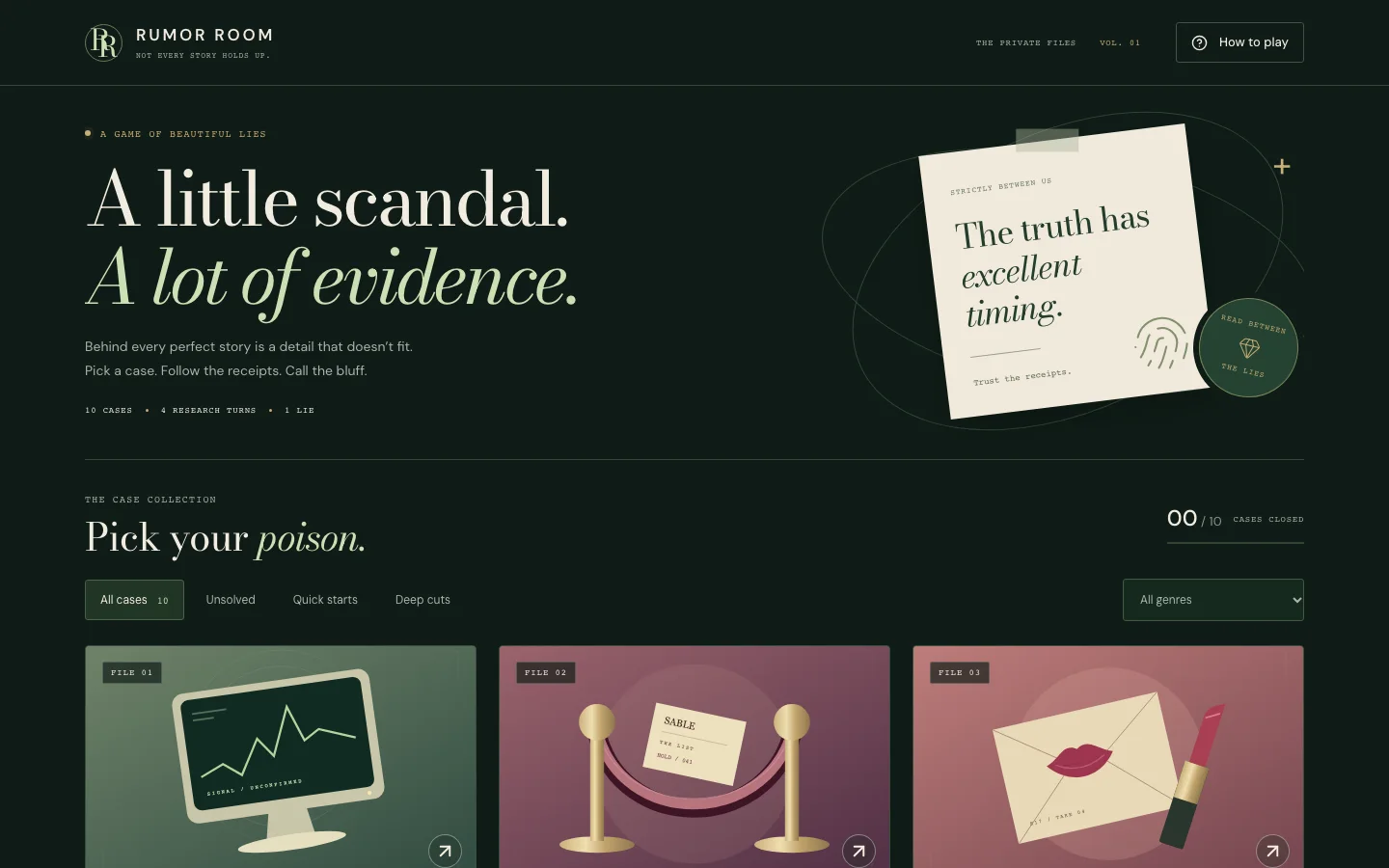
Ten fictional scandals. Four research turns. One story that doesn't hold up. A game about the distance between a convincing story and a supported claim.
Free to play · No account or API key · Progress saved in your browser
The idea
A good story can be a bad claim.
Rumor Room asks you to investigate before you accuse. Four claims arrive together; one fails under scrutiny. You have four research turns to work out which one and why. The interesting part is choosing what to check next.
I first built that loop around live web research. The follow-up keeps the deduction and gives it a different world: fictional founders, private clubs, secret romances, suspicious auctions, and people with excellent reasons to leave something out.
The current game
Make every case worth finishing.
All ten cases have authored evidence, prepared witness answers, an exhibit to inspect, and a fixed solution. The interface brings them together as a collection of private files: green ink, paper, illustrations, and receipts you can follow.
- Keep the constraint. Four turns force a choice. Spending them well matters more than clicking everything.
- Explain the verdict. The resolution cites the evidence, so a wrong accusation still teaches you what you missed.
- Finish the whole experience. The full collection works without a sign-in or model connection, with local saves, mobile controls, and keyboard-accessible dialogs.
The public release is a static site on GitHub Pages. It makes no inference calls, carries no API key, and needs no database. An optional live-witness adapter exists in the source but is disabled in this release.
The original AI build
When the web is the evidence board.
The original has three entertainment cases grounded in real web evidence. Every research turn runs Gemini through Google ADK and calls Parallel Search. The model chooses a research objective and turns the results into dated source receipts.
A server-side citation allowlist rejects URLs that did not appear in the actual search response. That limits invented citations; it doesn't make every source true. The player still has to assess provenance, timing, and whether the evidence supports the claim.
Built for the Agentic Cinema: The Blockbuster Hackathon, Parallel partner track, this version runs on Google Cloud Run. Its source, architecture, demo, and history remain available as the live-agent technical case study.
Open original live demo → Original source & write-up → Watch the demo → Architecture →
The product decision
Choose what the game needs to depend on.
Live research makes fresh evidence part of the game. It also brings search latency, provider availability, changing sources, and a cost for each investigation. Authored cases let me control the clues, pacing, and payoff, and keep the full game available without a paid inference service.
| Decision | Original AI build | Current game |
|---|---|---|
| Evidence | Live web search | Authored fictional sources |
| Cases | 3 entertainment investigations | 10 fictional mysteries |
| Runtime | Gemini + ADK + Parallel Search on Cloud Run | Static browser game on GitHub Pages |
| Tradeoff | Fresh sources, with latency and provider costs | Predictable clues and no inference cost; no live fact-checking |
The new game is the one I lead with when someone wants to play. The original shows how I built and bounded a live research agent. Together they show the engineering work and the judgment behind changing the product.